

Know what is worth improving first.
You do not need a finished software idea to start. We look for less repetitive work, clearer processes and better customer service.
What do you receive?
- A shared assessment of problems and improvement opportunities.
- A reasoned order of priorities, with expected benefits and effort.
- Agreed implementation steps and goals that can be evaluated.
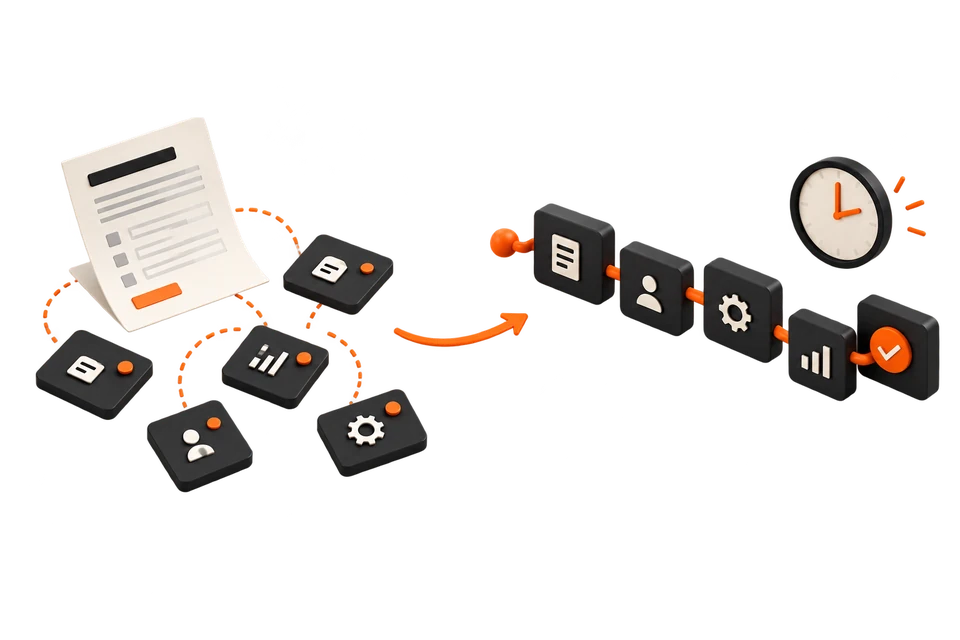
The first conversation helps us understand the situation and agree on how to proceed. The scope, time requirements and fee of any detailed assessment are agreed in advance. How contact and assessment begin →
How we work together.
- Initial discussion, in person if needed. We discuss your goals, difficulties, the people involved and the resources available. We get to understand the problem before choosing a tool.
- Assessing the current situation. We review workflows, software and hardware. We identify manual data transfers, repetitive tasks, potential errors and bottlenecks.
- Proposals and priorities. We weigh the size, frequency and business impact of each problem against cost, implementation time and adoption effort. Expected time savings, efficiency gains and financial payback are considered together. We also explain the assumptions and uncertainties in our estimates.
- Decision and implementation. Together, we select a proportionate first step: better use of an existing tool, a software or hardware change, an integration or custom development. The agreed solution is fitted to the existing infrastructure.
- Adoption and evaluation. We agree on handover, introduction and any ongoing operation. Results are compared with the starting situation to decide what should come next.

What makes a change worthwhile?
We first look at how work is done today and what you want to improve. We compare the expected benefit with the full effort and cost, making clear which inputs are known and which are estimates.
What takes time and money today?
- How often does the task or bottleneck occur?
- How much work goes into completing it, checking it and correcting errors?
- What delays, interruptions or service difficulties does it cause?
What does putting the solution into use involve?
- Assessment, configuration, necessary development and testing.
- Moving data, learning the new process and managing the changeover.
- Time from your team and the relevant service providers.
What costs and work will remain?
- Hosting, licences and other service fees.
- Monitoring, maintenance and later changes.
- Manual tasks and checks that the new process will still need.
Freed-up working time can be used for other tasks, but it does not automatically mean an equivalent reduction in payroll costs. We also consider clearer oversight, fewer errors and more predictable service.
If the expected benefit does not justify the effort, we recommend a smaller change or better use of an existing tool. The first step can be a trial or limited rollout; we compare the outcome with the starting situation.
Four situations and what we consider
These situations illustrate our assessment approach. The available solution and expected benefit depend on how the business actually works.
Phone orders and daily menus
The starting situation
Phone coordination, manual order entry and repeated summaries take time at the restaurant.
The digital approach
Order intake and traceable summaries tailored to the workflow can reduce these tasks.
We look at order volume, time spent on calls, entry and summaries, and the manual work that would remain with a new solution. We compare these with the cost of introduction and ongoing operation.
Excel summaries prepared by hand
- Today: data has to be collected, summarised and checked across several spreadsheets.
- Possible approach: summaries updated from a shared data source, or automation within an existing tool.
- What do we consider? Frequency, checking time, data quality and the work needed to connect the sources.
Copying data between older systems
- Today: the same data is entered in several programs, or files are moved between them by hand.
- Possible approach: system-to-system data transfer, a checked import process or replacement of a part where justified.
- What do we consider? Available integration options, data reliability and the work involved in changing over.
Tasks and approvals getting stuck
- Today: extra conversations are needed just to find out where work stands and who is next.
- Possible approach: shared status tracking, clear responsibilities and relevant notifications.
- What do we consider? Waiting time, interruptions, permissions and the everyday usability of the new process.
Web presence and marketing pages, online sales and IT hosting and operation can be parts of the same improvement plan. The linked service pages explain the implementation options.
Examples and decision criteria in more detail
How things could be simpler
- Orders in one place. Online ordering can take some phone coordination and manual summaries off your team’s hands.
- Less copying of data. We explore how your systems could exchange data instead of repeated entry, manual Excel summaries and USB transfers.
- Traceable tasks and approvals. We can make it clear where work stands, who owns the next step and who needs to be notified.
- Your own online sales. Together we plan the steps needed to start, from presenting products through ordering and payment to invoicing.
- An app idea you can discuss. Together we clarify whom the app would help, which features matter most and what the first testable version should include.
- More dependable daily operations. We investigate what slows down or interrupts the system and recommend improvements, modernisation or a more suitable operating setup.
What do we weigh before deciding?
We look at how often the problem occurs, the time and cost it creates, and the cost of introducing and operating a solution. We weigh expected savings against those costs and the effort of adoption, making assumptions and uncertainty in the estimates clear.
We start with recurring problems and the tools you already use. Better settings in an existing system, connecting a few manual steps or a simpler tool may be enough. We recommend custom development when it offers a proportionate solution to the problem.
Working together at a glance
- Understand the goal. We review where you are today and the result you need.
- Make a proposal. Together, we weigh benefits, effort and possible solutions.
- Build and support. We deliver the agreed work and define the terms of continued support.
Where next?
- Already know what you need? Choose a service direction.
- Need a custom workflow or system connection? Explore custom development.
Related project developed by us: Zabizz – restaurant platform. Awaiting launch.